 ApocToObj
ApocToObj | BAABE | BSP front-end | Chocks Away source code | Chocks Away Extra Missions patch | ChocToObj | Cogs | Inferno patch | Launcher | Magic Mushrooms | Magic Pockets patch | Marsquake levels |Mico Joystick Driver | Music Ripper's Toolkit | New desktop icons | Noughts | Oddities collection | TubeWhackOMatic | Tutenkhamen's Tomb | Type | XmasTime
This software is designed for computers running RISC OS. The title and icon of each program are linked to the relevant Zip archive for download. On RISC OS computers Zip files may be opened using SparkPlug, SparkFS (commercial) or Infozip. You can see full-size versions of some of the screenshots by clicking on the thumbnail images.
Items related to the game Star Fighter 3000 (SFpatch, SFtoSpr, RedefKeys, documentation) have moved to my Star Fighter 3000 web home.
ApocToObj
Apocalypse is a single-player 3D shoot 'em up for Acorn Archimedes computers, written by Gordon Key. The game world is drawn using a combination of flat-shaded polygon meshes and sprites. Most of the targets in the game are animated and have amusing names such as 'weirding flasher' and 'proton flapper'.
This command-line program can be used to convert object models for the game from their original format into the simple object geometry format developed by Wavefront for their Advanced Visualizer software. OBJ format is a de-facto standard for 3D computer graphics and it has the advantage of being human-readable.
You can browse the source code on GitHub.
0.02 (22 Apr 2020)
 BAABE
BAABE
BAABE (don't ask) is a freeware interactive fiction interpreter and framework for RISC OS. This archive contains full documentation of what it is, how to play it and how to create games using it, as well as three (well, two) example games.
The headline feature is the engine's extraordinary capacity for translation and internationalisation. All text, from cut scenes to verb handles, is held in message files looked up by means of ResFind. It goes beyond that, too - the sentence structure the player enters commands in is not fixed, so depending on the configuration, 'put ball in bag' and 'bag put the ball' could both be valid commands.
The only requirements for programming using BAABE are a reasonable amount of experience in BASIC, and a lot of imagination!
Writer's block permitting, I hope to have a longer adventure out using this system in the middling future. (Well, there was supposed to be one out now, but we won't go into that...)
This archive last updated 4th November 2009
 BSP nodes builder front-end
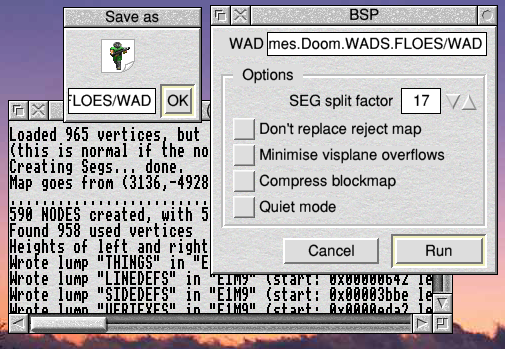
This is a front-end to Colin Reed and Lee Killough's excellent Doom BSP node builder. It allows an input Doom WAD file and various options to be set in a desktop interface, and then invokes BSP using these parameters. When BSP has finished building the nodes, the resultant WAD file can be saved using drag and drop.
I use BSP because I mistrust the nodes builder built into DETH, which in my
experience tends to produce visual artifacts and sometimes
crashes entirely. This may be just my tendency to create
over-complicated levels (and ignorance of the
-SplitFactor command line option, which I only just
noticed).
This archive contains a brand new port of BSP, based on version 5.2, which has been updated and called version 5.3. You will also require the FrontEnd and DDEUtils modules from Acorn's Desktop Development Environment. DDEUtils is quite widespread (and seems to be in ROM on later OS versions), but getting hold of FrontEnd might prove more difficult...
5.3 (7th August 2010)
BLOCKMAP
lump output was larger when using the compressed blockmap
generator and processing a multi-level WAD.
fwrite() was called with a
null FILE pointer if output had been directed
to a temporary file and the final attempt to open the
actual output file failed (caused a data abort on
RISC OS).
open() and fdopen().
 Chocks Away source code
Some time in December 2017, I decided to reverse-engineer the 3D model file format for Chocks Away, starting from a disassembly of the executable file for 'Chocks Away Extra Missions' produced by ARMalyser. The project grew in scope to encompass the entire program, as I sought the answer to niggling questions such as "How does it decide whether or not an object mesh requires backface culling?"
This is a work in progress: some labels and names may be a result of wrong inferences/guesses. It would be possible to make the code more maintainable, e.g. by use of literal pools, but that would make it impossible to compare the assembled code directly with the original for validation. For the same reason, suspect code (including dead and redundant code) has been annotated with 'bug' comments instead of fixing or deleting it.
1 (14 Oct 2018)
 Chocks Away Extra Missions
patch
Chocks Away Extra Missions
patch
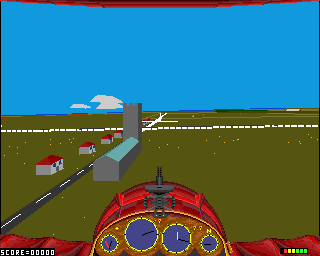
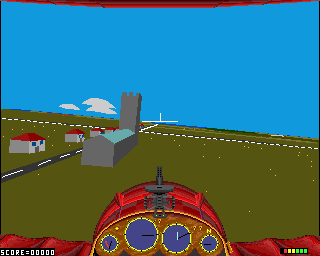
The first patch fixes several graphical errors that mar the otherwise-excellent supplement for Chocks Away, 'Extra Missions', which was published by The Fourth Dimension in 1991.
A second patch was added at the suggestion of Jeffrey Doggett to fix more bugs (using his solutions). The first two bugs below were already patched or otherwise worked around at run time if using the "ChocksAway frontend v1.50" "by Keith McKillop 1998/1999/2000" but fixing them in the stored code too does no harm.
The following bugs are fixed by the 'Chocks_2b' patch:
R10-R12 are loaded from
temporary memory upon returning to the game code after
taking a reconnaissance photo but their values were not
stored before leaving. This would cause a crash if zero
page were protected, otherwise undefined behaviour.
NV.
This may be incompatible with newer ARM processors.
|
|
| Before patching | After patching |
2 (26 Apr 2020)
ChocToObj
Chocks Away is a flight simulator for Acorn Archimedes computers, written by Andrew Hutchings (interviewed here). Its game world is drawn using a combination of flat-shaded polygon meshes, lines and points. Its 3D models of aircraft, buildings, bridges and other structures are primitive but I think they have a certain charm.
This command-line program can be used to convert object models for the game from their original (optionally compressed) format into the simple object geometry format developed by Wavefront for their Advanced Visualizer software. OBJ format is a de-facto standard for 3D computer graphics and it has the advantage of being human-readable.
More information about the converter and file format is available on dedicated pages.
0.03 (21 Apr 2020)
 Cogs
Cogs
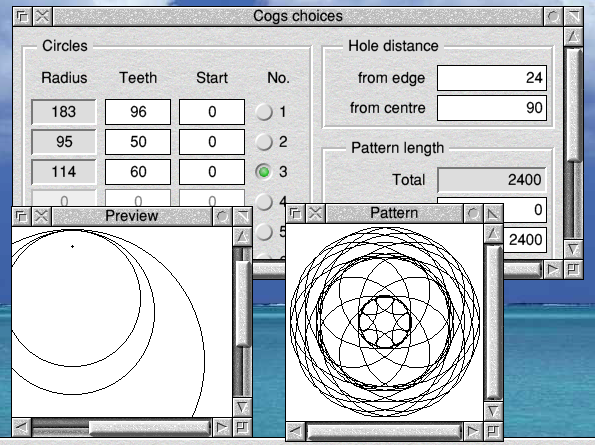
Did you ever play with a Spirograph set when you were younger? There were a number of different-sized gears with holes in just big enough to push the point of a pen through, and these gears fitted into larger 'plates' (circular holes with teeth round the inside). You pushed your pen through a hole in a gear and rotated the gear around the plate. One of many things may then have happened, one of which involved the production of an amazing geometrical pattern and most others of which involved curse words and, if necessary, Sellotape.
This program allows you to draw Spirograph patterns without the need for purchasing a set or importing special American-specification paper to fit it. Simply specify the number of teeth around the wheel, the number of teeth around the plate and the 'hole' you wish to put your 'pen' in and away you go!
2.00 (3rd January 2011)
 Inferno
patch
Inferno
patch
A simple, easy-to-use program which will remove the copy protection from your copy of Inferno, removing the requirement to have the original floppy disc in the drive before playing. Apart from making the game playable on emulators, this also guards against the inevitability of the by now ancient floppy ceasing to work. (And it's much less irritating, too!)
Note that this will not make the game 32-bit compatible, so you'll still have to play it on an old computer.
Last updated Sunday the 17th of March, 2013
 Launcher
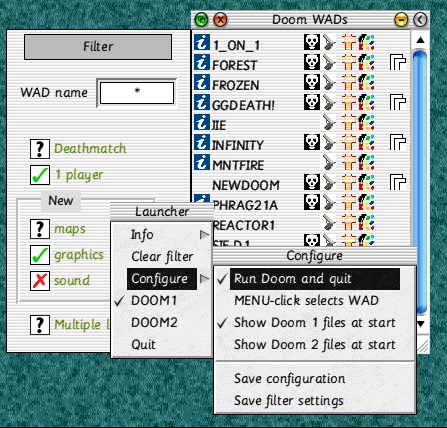
This program provides an easier way to load and run the large number of public domain Doom levels supplied on the bonus third CD-ROM of the boxed set (named 'Maximum Doom'). The list of WAD files may be filtered by name or whether they contain deathmatch, new maps, new graphics, new sound, or more than one level. The problem of it taking nearly five minutes to open a directory containing 1,960 files (the Doom II patch WAD files) is also avoided, and help files are accessible whether or not they are correctly named.
1.15 (15th June 2000)
 Magic
Mushrooms
Magic
Mushrooms
(Notes: requires TimPlayer by André Timmermans.)
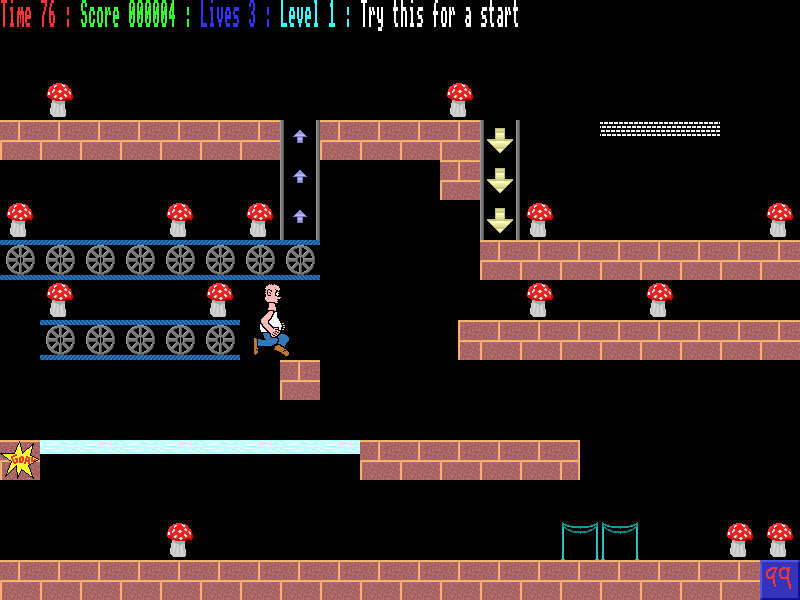
This is a RISC OS version of a platform game originally written by Neil Raine, which Martin loved playing on the BBC microcomputer. It features new graphics, sound, and level data, but the fundamental concept is the same (collect mushrooms within a time limit whilst avoiding roving monsters). The original game is available for download from Stairway To Hell.
1.13 (7th August 2012)
 Magic
Pockets patch
Magic
Pockets patch
Another patch program which works the same way and does the same things as the Inferno one, but this time for Magic Pockets. No longer need you play the game with the original floppy disc in the drive, assuming you have a floppy drive, and that you're not playing on an emulator. This will also rescue you if your twenty-year-old original floppy disc is now broken.
As before, the game remains limited to 26-bit hardware; all the patch does is remove the copy protection.
Last updated Wednesday the 21st of August, 2013
 Marsquake levels
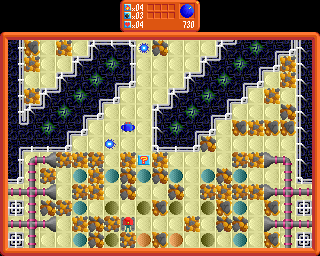
Six sets of new levels for Paul Taylor's game Marsquake, of varying vintages and quality, designed by Martin Bazley. Some of the earliest are about the same age as his earliest Doom levels, which should give you an idea of quality... Some are rather fun, however.
Last updated Monday the 15th of June, 2009
 Mico Joystick
Driver
Mico Joystick
Driver
This is a module that adds support for up to two standard PC analogue joysticks connected to the gameport of a MicroDigital Mico computer. Because it implements the standard Joystick SWIs it should be compatible with all existing and future RISC OS software. The new calibration and 16-bit read SWIs introduced in RISC OS 3.6 are also supported.
Extensive documentation for both users and application programmers is included in the archive, together with a program to allow joysticks to be easily calibrated and tested. I welcome feedback from other users, having only been able to test it with my own (rather knackered) PC joystick.
The module is released under the GNU public licence, and comes with full source code. You can browse the source code on GitHub.
2.02 (18th September 2004)
 Music Ripper's
Toolkit
Music Ripper's
Toolkit
The Music Ripper's Toolkit is a selection of programs dedicated to ripping music from games and demos. Some are automatic but narrow in scope; some are versatile but require some effort on the part of the user. Comprehensive instructions are supplied for ripping all games and demos it has been tested with. Reports of tests with other programs are welcome.
This collection is in no way guaranteed to be 32-bit compatible. Several old modules are supplied and will not work. Apart from anything else, many of the games in question are also not 32-bit compatible themselves, and many need to be successfully run in order to extract the music.
This archive incorporates, for completeness, the Star Fighter 3000 to ProTracker convertor by Christopher Bazley.
Martin Bazley, Christopher Bazley and various others
Release 3 (14th March 2010)
 New desktop icons
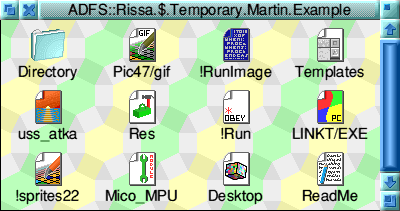
A set of 75 new file and directory icons for the RISC OS desktop. Also included is an alternative set of window border sprites and a replacement window background tile. Together, these give the desktop a more colourful appearance than its usual drab grey. All the new icons are designed for the default 256 colour palette.
The screenshot opposite shows a highly contrived directory display containing many different types of file (to show some of the new icons).
20th December 2006
 Noughts
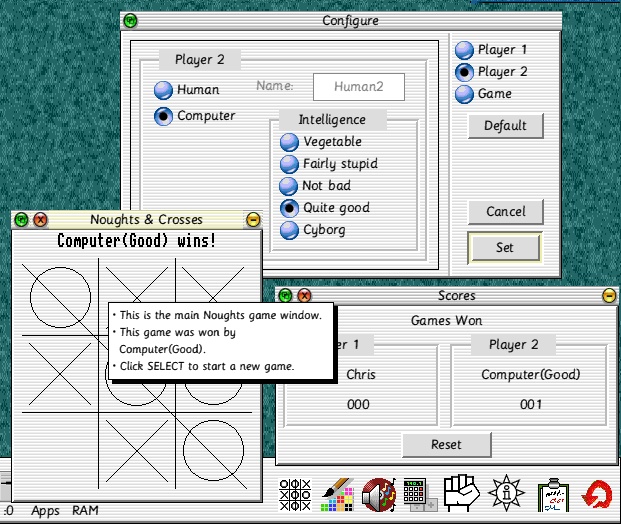
Possibly the best desktop version of 'Noughts & Crosses' available for RISC OS. Unfortunately, I didn't do my market research beforehand, and apparently no-one wants to play 'Noughts and Crosses'... (Historical note: actually I'm not that clueless - it was originally an A-level computing project, but subsequently became something of an obsession!)
You may play against computer opponents (of varying ability) or other people. Will also keep track of the score. Fully configurable and supports interactive help.
1.67 (6th September 2003)
OS_File 18 instead of
*SetType and OS_File 8 instead of
*CDir.
Oddities collection
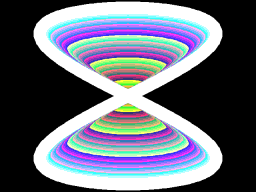
A large collection of BBC BASIC programs that draw a variety of different patterns on the screen. Also, a non-graphical fruit machine simulator and a program to generate listings of filing system contents (in plain text or HTML format).
New in release 3:
7th October 2008
 TubeWhackOMatic
Inspired by Ben Green and this discussion on the Icon Bar, I have written a program to generate the shortest possible (well, probably) Tubewhacks for every station on the London Underground network. Main line stations, DLR stations and London Overground stations are not included, but you can easily add them yourself. Due to recent events, the East London line is deemed to fall under the latter category.
Release 2 (15th September 2011)
 Tutenkhamen's Tomb
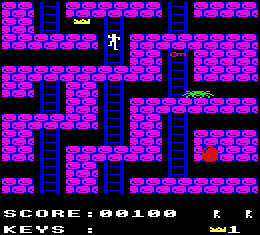
This is an old game for the BBC Microcomputer, updated to work on RISC OS computers. You control a little man from a side-on viewpoint, with a new screenful of scenery displayed when you reach the edge. The graphics are fairly simple, but the gameplay is actually pretty challenging.
The player must escape an egyptian pyramid, collecting keys (which open the door of the same colour), and treasure. Deadly spiders patrol the corridors, and the player must plan his route to avoid being trapped by falling boulders.
Included is a level editor - TutenEd - written for my brother Martin by Harriet. This allows alternative layouts of corridors and ladders to be created, and objects added and removed. In addition, the updated version of the game allows different level sets to be played, and records a high score for individual levels.
Original author unknown, updated by Christopher & Harriet Bazley.
Level editor by
Harriet Bazley.
1.3 (10th September 2000)
 Type
Type
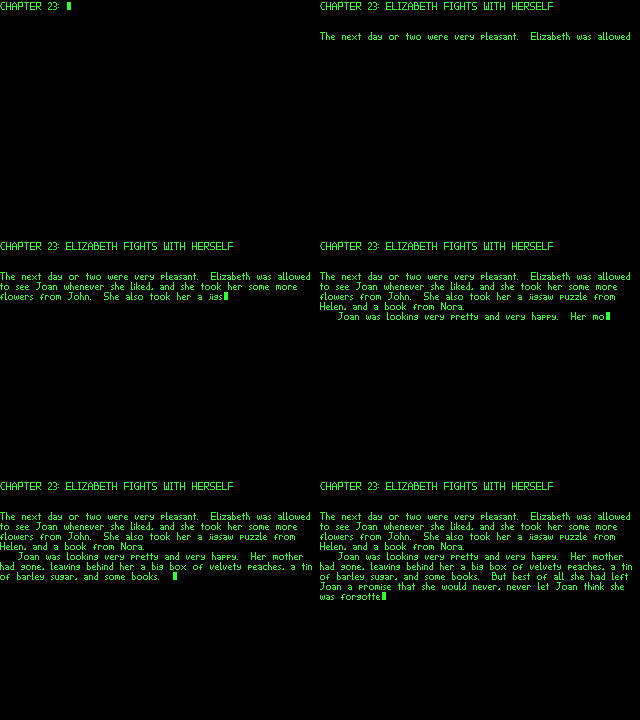
Type is a silly program which takes a text file and displays it, character by character, on the screen. As each character is displayed a sound effect is played. There's really not a lot more to say.
Actually, you can do more than that. You can customize the font, the background colour, the text, the letter spacing and even the sound until the program is exactly (?!) the way you want it.
As for possible uses? Search me! You might be able to utilize it in a presentation, I suppose...
NB: Not to be confused with Typer.
2.03 (26th May 2007)
*Echo command in the
hardcoded configuration with a more conventional
PRINT. I had hoped it would allow me to display the
warning in a window, but it doesn't.
XmasTime
XmasTime is a very small BASIC program that Martin wrote for the festive season, although it will in fact work all year round. It displays the number of days left until the next Christmas, not to mention a variety of seasonal (and not always polite) messages as the day gets closer. It is fully leap-year compliant, just in case you should have your computer's internal clock set to the year 2100.
0.3 (1st March 2008)
AND has priority over
OR.